
季承成 | CHENGCHENG JI
计算机科学与信息技术 博士 | Ph.D. in Computer Science and Information Technology
摘要/ABSTRACT
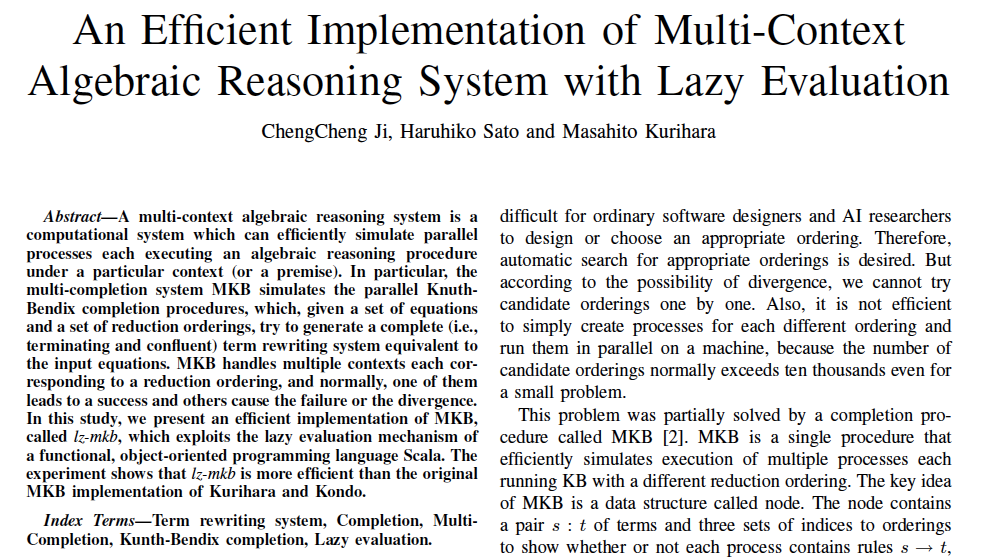
A multi-context algebraic reasoning system is a computational system which can efficiently simulate parallel processes each executing an algebraic reasoning procedure under a particular context (or a premise). In particular, the multi-completion system MKB simulates the parallel Knuth-Bendix completion procedures, which, given a set of equations and a set of reduction orderings, try to generate a complete (i.e., terminating and confluent) term rewriting system equivalent to the input equations. MKB handles multiple contexts each corresponding to a reduction ordering, and normally, one of them leads to a success and others cause the failure or the divergence. In this study, we present an efficient implementation of MKB, called lz-mkb, which exploits the lazy evaluation mechanism of a functional, object-oriented programming language Scala. The experiment shows that lz-mkb is more efficient than the original MKB implementation of Kurihara and Kondo.
作者/Authors
ChengCheng Ji, Masahito Kurihara, Haruhiko Sato
会议信息/Information
Lecture Notes in Engineering and Computer Science: International MultiConference of Engineers and Computer Scientists 2015, HongKong, China, pp. 201–205 (EI).